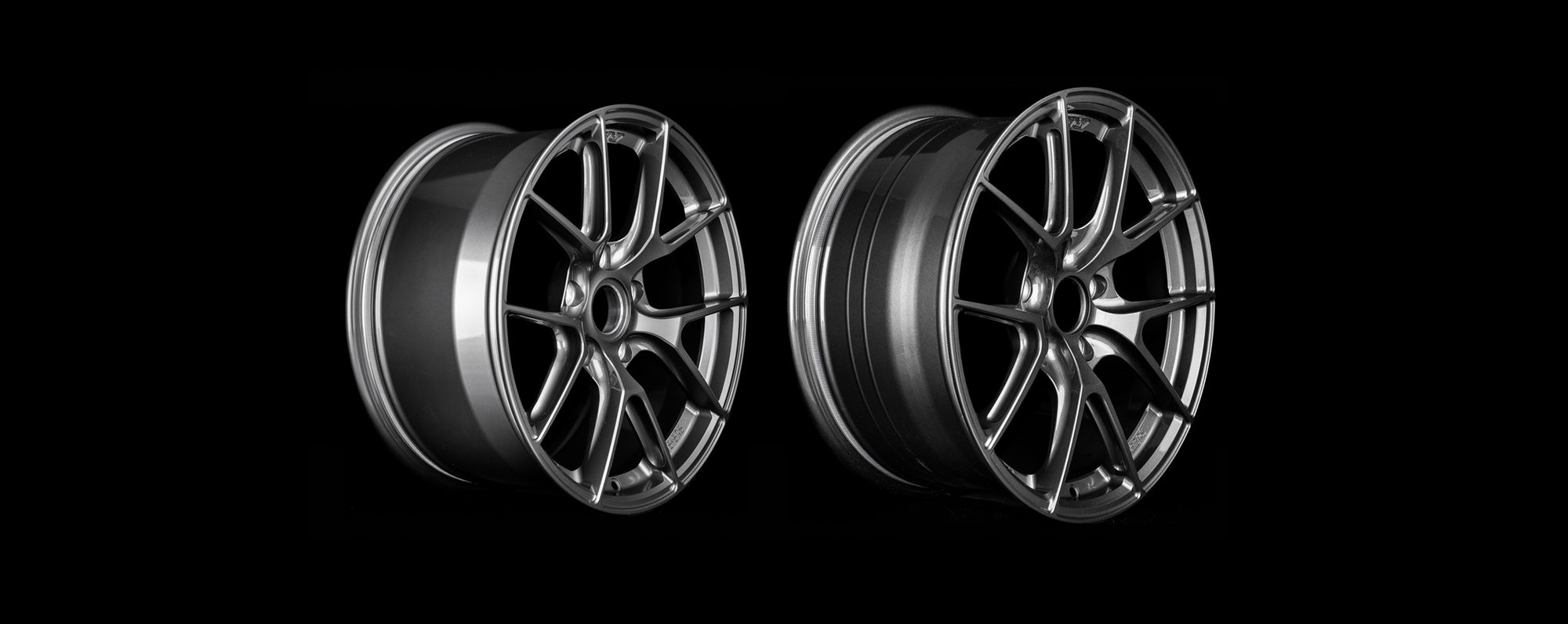
Counterfeit Wheels Exposed: Side-by-Side vs Authentic Apex Wheels
Article | 02/27/2026 by Dan Cope
Updated on 03/23/2026
Don’t Get Scammed: Counterfeit Sellers are Lying to You
One of the most dangerous misconceptions that we see spreading across social media is that cheap counterfeit wheels are the same as authentic Apex wheels. Lies are being spread that they are “backdoor” versions from the same source, just sold without the markup. Don’t get fooled by that scam. These claims are spread by counterfeiters trying to create false credibility to increase demand, when in reality the wheels are completely unrelated to authentic products and are inferior in form and function.
In summary:
- Apex does not share production with counterfeiters. There is no “secret access” to our factory.
- Counterfeit wheels are fundamentally inferior in engineering and execution.
- They skip our intensive R&D process: No repeated test fitting, no precision 3D laser scanning, no obsessive refinement of critical engineering details.
- They don’t start with our specialized forging blanks, which are the structural foundation everything else depends on.
- They don’t have access to our 3D CAD models, meaning their final product is guesswork, not precision.
- Counterfeiters lie about testing and certification, deliberately misleading customers with no accountability and no proof to back up their claims.
They can fake the look, but not the engineering, performance, or safety. That’s where enthusiasts should be concerned.
Fake products are largely promoted through social media shorts and marketplaces like Facebook, with paid influencers using clickbait headlines to promote the lies and false narratives driven by counterfeiters. This article is meant to give enthusiasts accurate, concise, and factual information to help stop the spread of misinformation, particularly as it relates to Apex wheels within the growing counterfeit misinformation problem.
As of now there’s no actual analysis or fact checking being done by influencers and commentators. Enthusiasts are trusting the opinion of unqualified individuals whose sole motivations are simply to drive traffic to paid affiliate links or to grow their audiences with clickbait opinions. There’s no technical analysis, no engineering details, and no talking about the things that actually matter when it comes to performance. None have ever done a side-by-side comparison because the differences between the products are obvious and would instantly disprove the claim that they are the same as our wheels.
Counterfeits are a well known issue across industries. Despite this, many people don’t question the validity of the counterfeiters’ false claims despite how “too good to be true” they are. This has fooled many people into believing that they are buying from a legitimate source, when in fact they are buying from a source willing to mislead customers and cut corners to sell more.
Key Differences
A Side by Side Comparison
We ordered a set of counterfeits in an identical size and comparable finish to our own wheels so we could do a direct comparison where enthusiasts can see examples of differences side by side. We want to show why these fake wheels are forced to make those compromises and how that affects you.
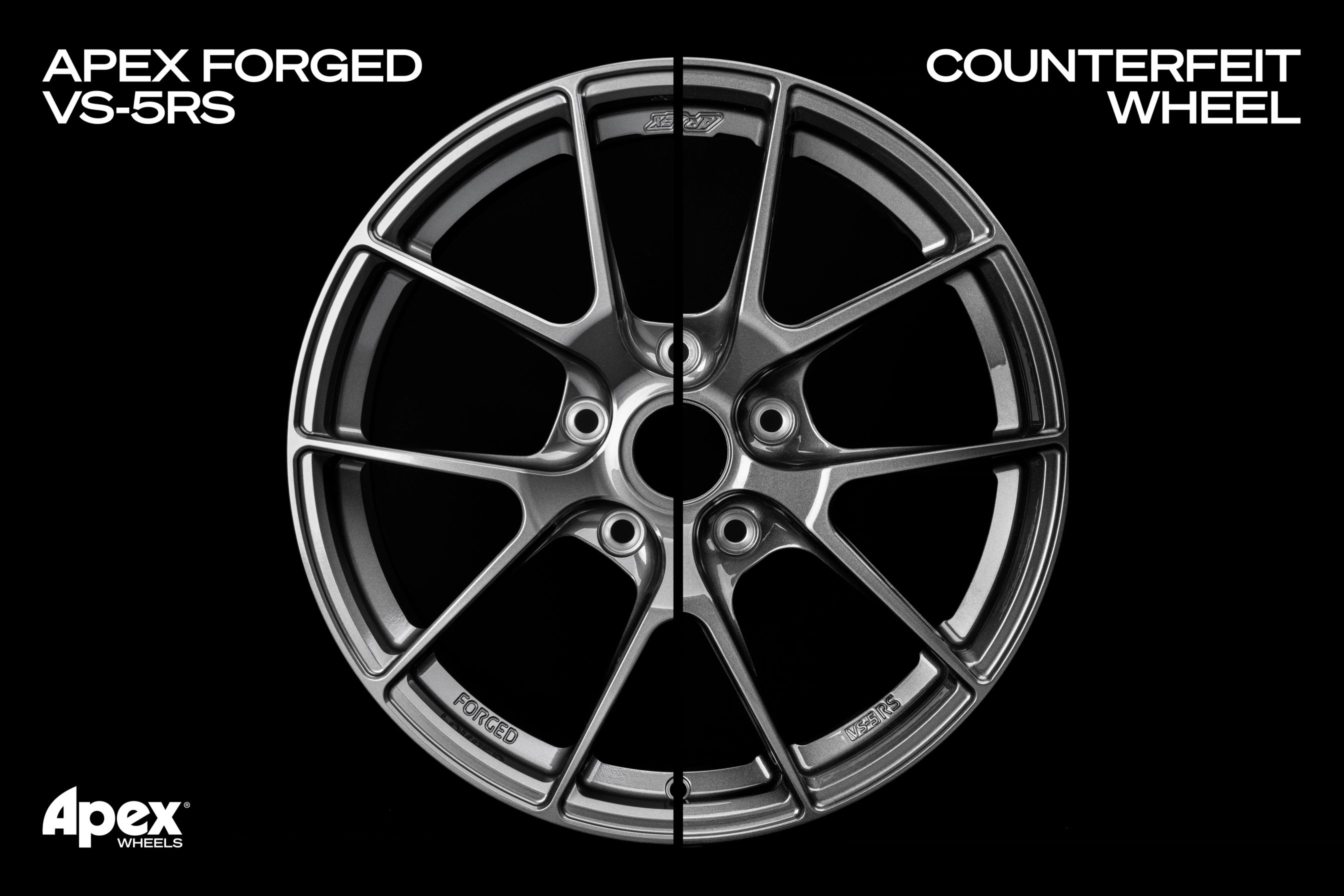
At first glance the fakes may look very similar to authentic wheels, but that quick glance is where the similarities end. Even small changes to the design of a high performance wheel can have significant impacts to the strength, stiffness, brake clearances, and other features and functions.
The most common reason that people wrongly believe the counterfeits are from our manufacturing partner is because counterfeit listings steal our trademarked logos, product renders, and videos. These listings also illegally use our copyrighted images, which results in customers seeing our product photos and on-car photos but receiving different quality products when they open the box.
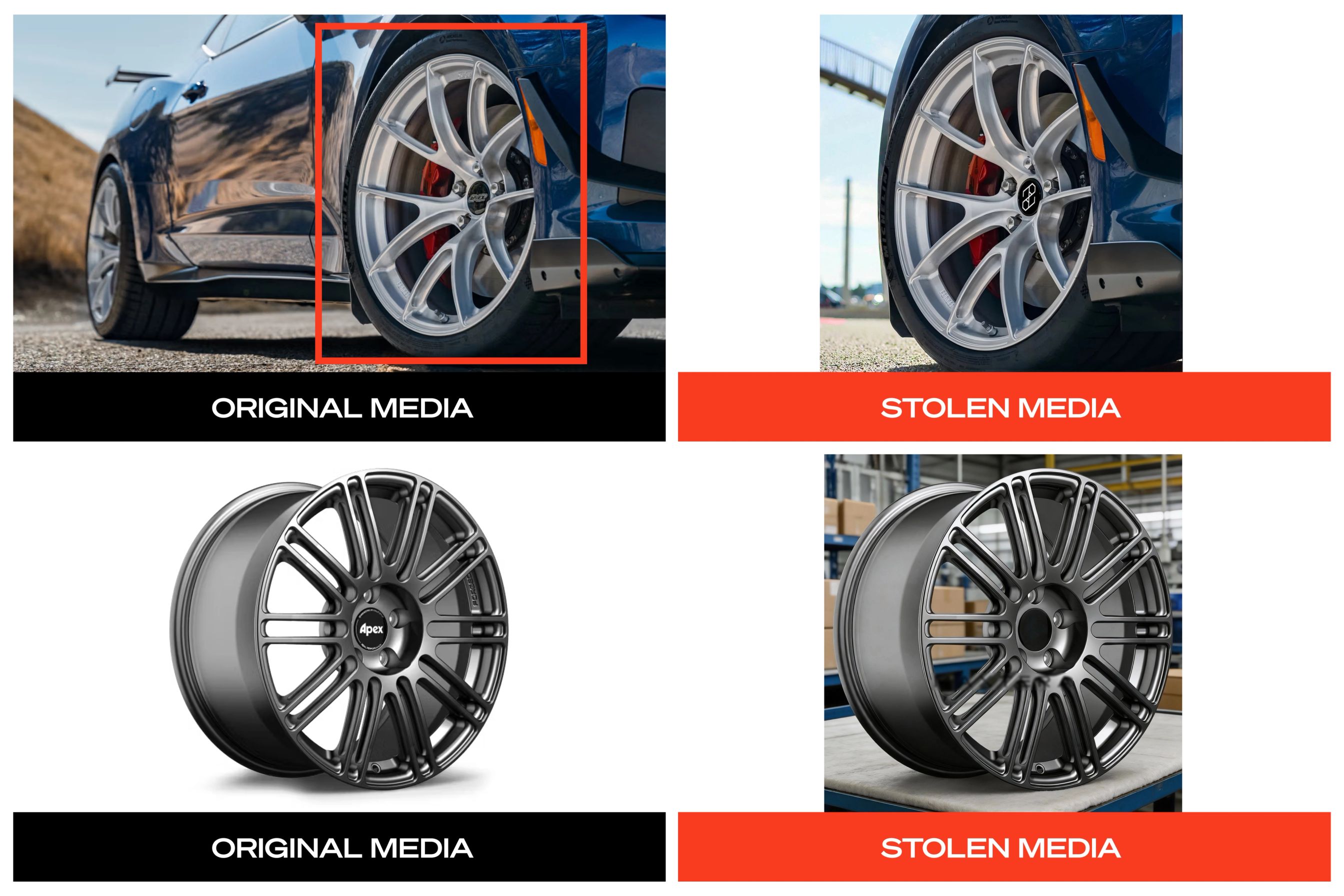
The above image shows examples of images stolen from our site and then photoshopped with different backgrounds, cropping, and center caps. When our ML-10RT was launched, our copyrighted images and videos were being used within days, giving some people the impression that we were the ones buying from those suppliers. In reality, they hadn’t even created a CAD model yet, but they were promoting availability using our imagery. They did the same with the TC-10RT images above. We’ve yet to see an image of a real world counterfeit for that model, but we have seen our content manipulated.
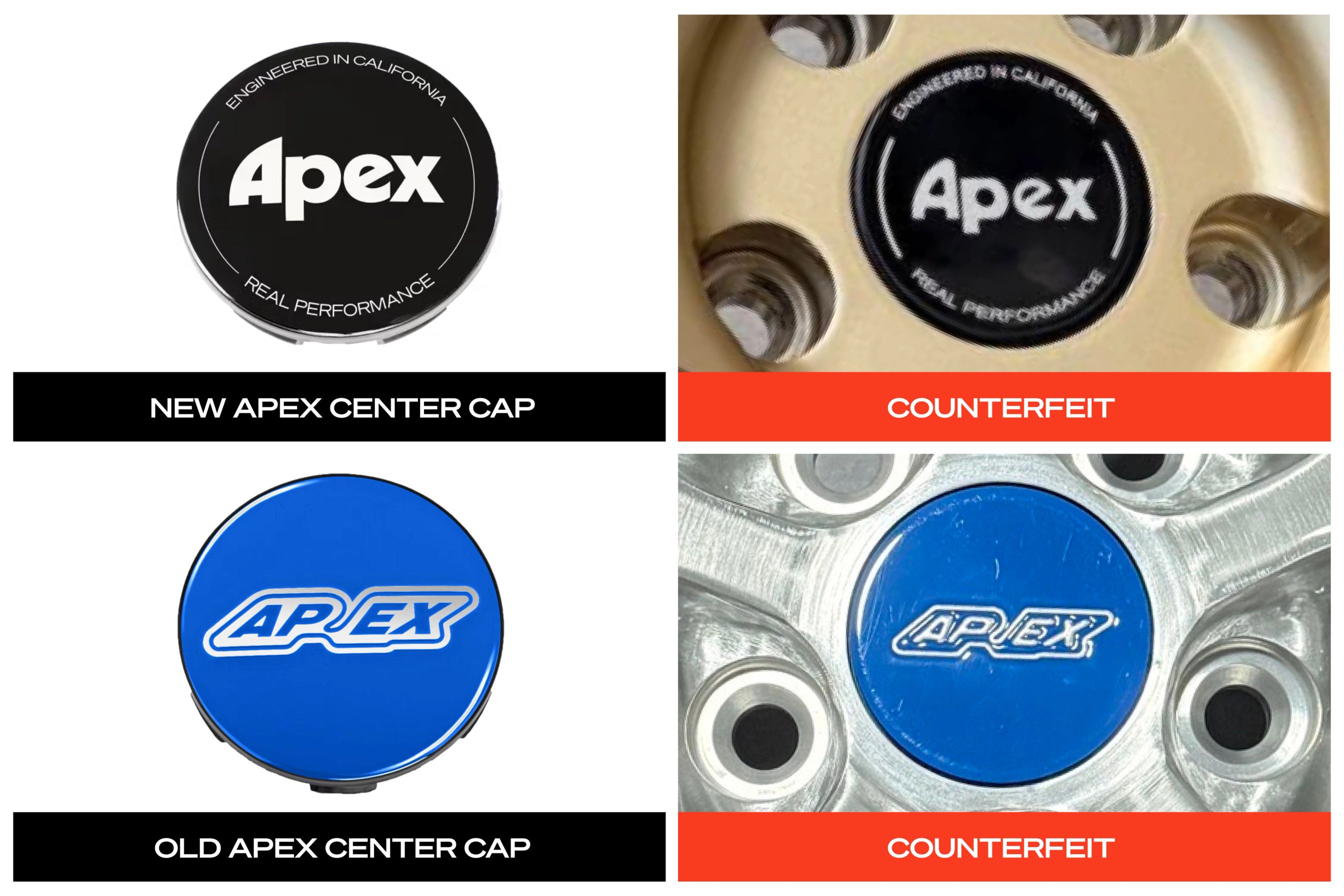
Counterfeiters also steal trademarked logos from our site and the web to make center caps and wheel engravings. Some are executed very poorly, as seen in the image above, but it’s often not apparent until arrival. While we do get a laugh at some of these, it’s proof that quality is being compromised during the most basic design and production stages, and is another example of why counterfeit wheels have no relation to authentic Apex products.
Fakes are Heavier:
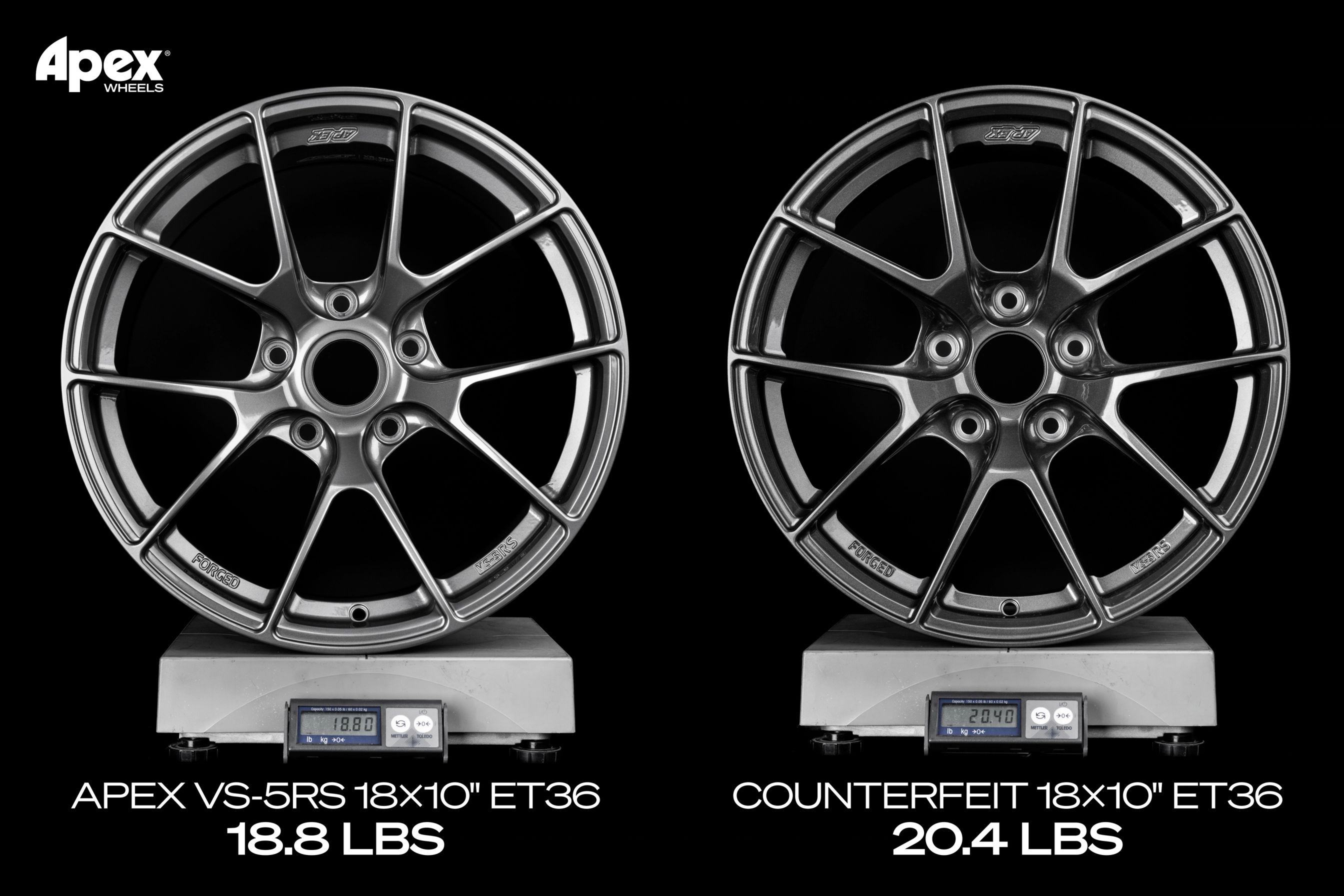
Consider the most basic performance feature, a wheel’s weight. Every counterfeit wheel that we’ve ever measured (or that we have seen measured) has been significantly heavier than an authentic Apex forged wheel in an equivalent size. In most cases the difference is multiple extra pounds, with the counterfeit wheels being closer in weight to our less expensive flow formed wheels.
It begs the question: If they weigh more, how can these counterfeits be the same? Only a material or dimensional difference would explain why they weigh more. If the material or dimensions are different, then how could these wheels be associated with authentic versions in any way?
The reality is that they aren’t the same design because they have nothing to do with authentic products. Counterfeits don’t come from the same factory, the same engineers, or the same forging blanks. Counterfeit wheel companies use 2D photos off of our site to model a 3D part, but in doing so they miss out on critical design details. Everything is approximated: every angle, every dimension, and every feature.
By designing wheels this way they aren’t matching our standards for strength, stiffness, clearances, or performance. Their objective is to look similar enough to an uninformed buyer, not to be identical.
Fakes are Made from Cheap Forging Blanks
Forged wheels start from a forging blank. The blank is like the canvas of a painting, where the size and shape of the canvas limits what can be created. Our engineers spent years developing our own specialized wheel blanks in order to ensure we could clear more brakes, create lighter and stiffer designs, and add a lot more inner lip strength. Counterfeit wheels are made from generic, cheap forging blanks that are extra thin and lack available material in key areas needed for performance applications in order to cut costs.
This results in compromised features such as spoke depth, barrel profile, inner lips, and more. It’s impossible for a counterfeit to match our wheel’s design because they physically can’t put material where we do.
Consider the image below and notice how out of bounds the red line goes in the barrel and spoke area.
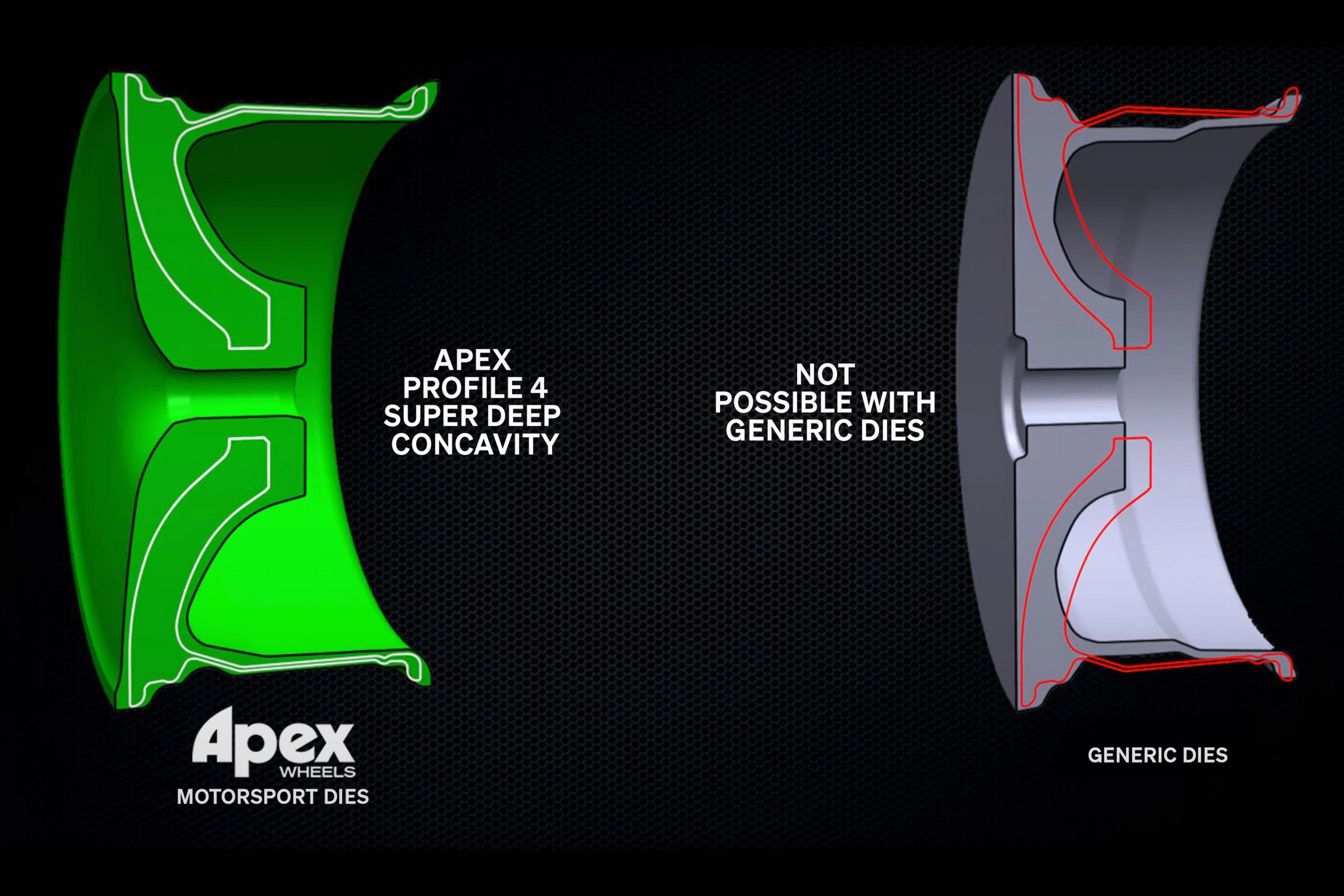
These off the shelf, economy-focused blanks save the counterfeiters a lot of money, as the blanks they buy use much less material. To make the cheap blanks work, their designers compromise and change the dimensions of the spoke to fit within the blank’s restrictive and thin profile while trying to keep the face-on style of the wheel as close as possible.
The additional material used in our proprietary blanks is significant: a typical 18” blank may weigh 80-90 pounds before machining, while ours weigh ~120 pounds. While that additional material is expensive and less efficient than off the shelf economy blanks, the additional engineering flexibility it provides is critical when optimizing a wheel for weight, strength and stiffness, not just style.
Fakes Compromise the Spokes
Once you get closer to the wheel, you can really start to see the differences and how the thinner blank compromises the overall design. These wheels may appear similar when viewed straight-on, but in the image below you can see that the spokes on authentic Apex wheels are almost 30% deeper front to back. That’s a terrifying change on a high performance product engineered to the limits. Spoke depth like ours is how high strength and stiffness is achieved in a wheel.
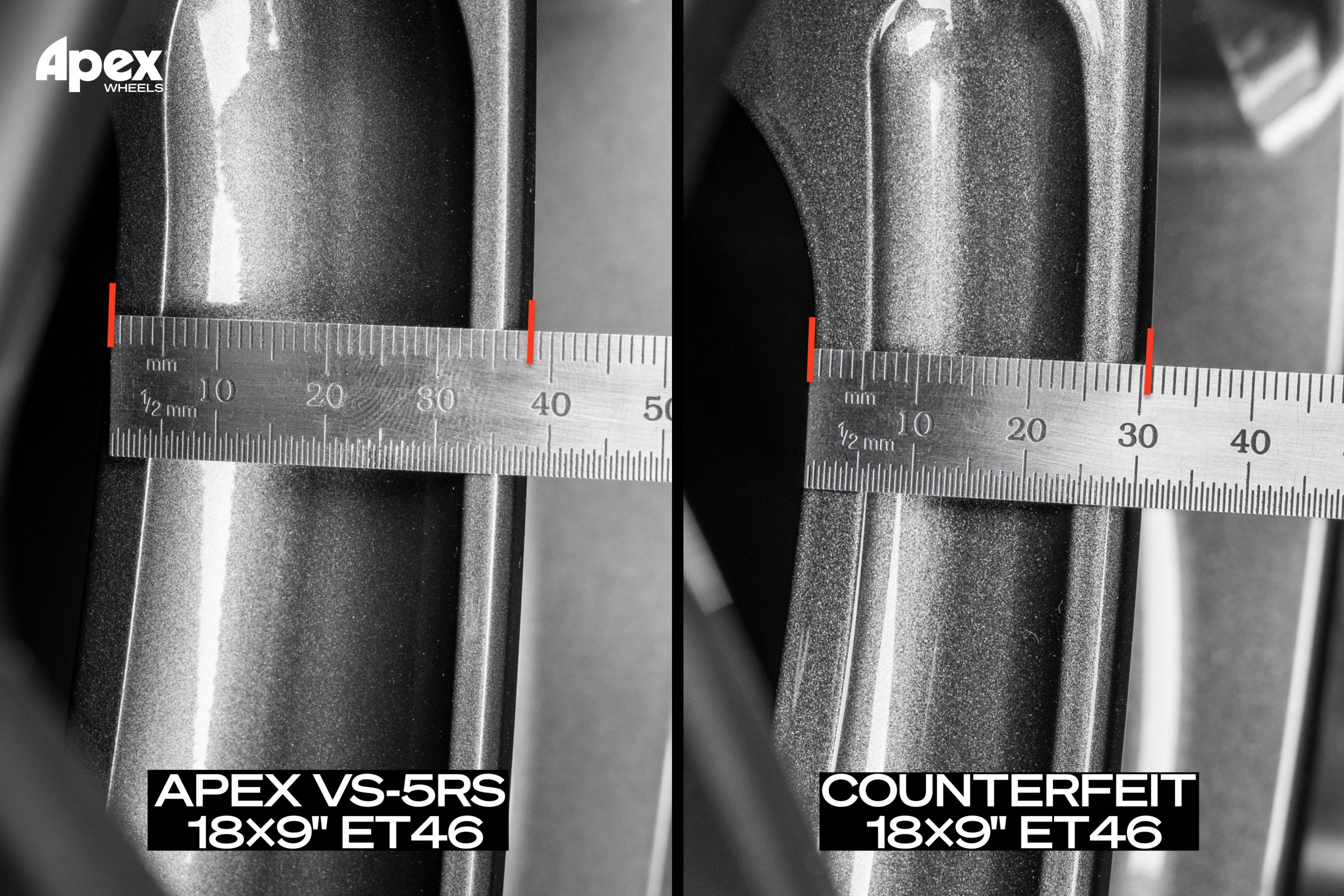
The proof is in the data: after reverse engineering the wheels, we found that our front wheels are 24.7% stiffer compared to the counterfeits. Even our flow-formed SM-10’s in the same size are stiffer than the forged counterfeits, which goes to show how a compromised design can waste the benefit of forged construction.
Also worth noting is the width and depth of the side-milling (material removal) in the image above. The additional spoke depth allows us to mill a much wider cut into the spoke, which sheds 1.2 pounds of weight compared to a wheel without it. On the fake wheels it’s essentially cosmetic – their side milling saves just 0.35 pounds, nearly a full pound less than our milling.
Once you begin to understand the differences, it’s possible to spot a fake just by looking at the spokes and side milling.
Fakes Have Compromised Barrel Profiles
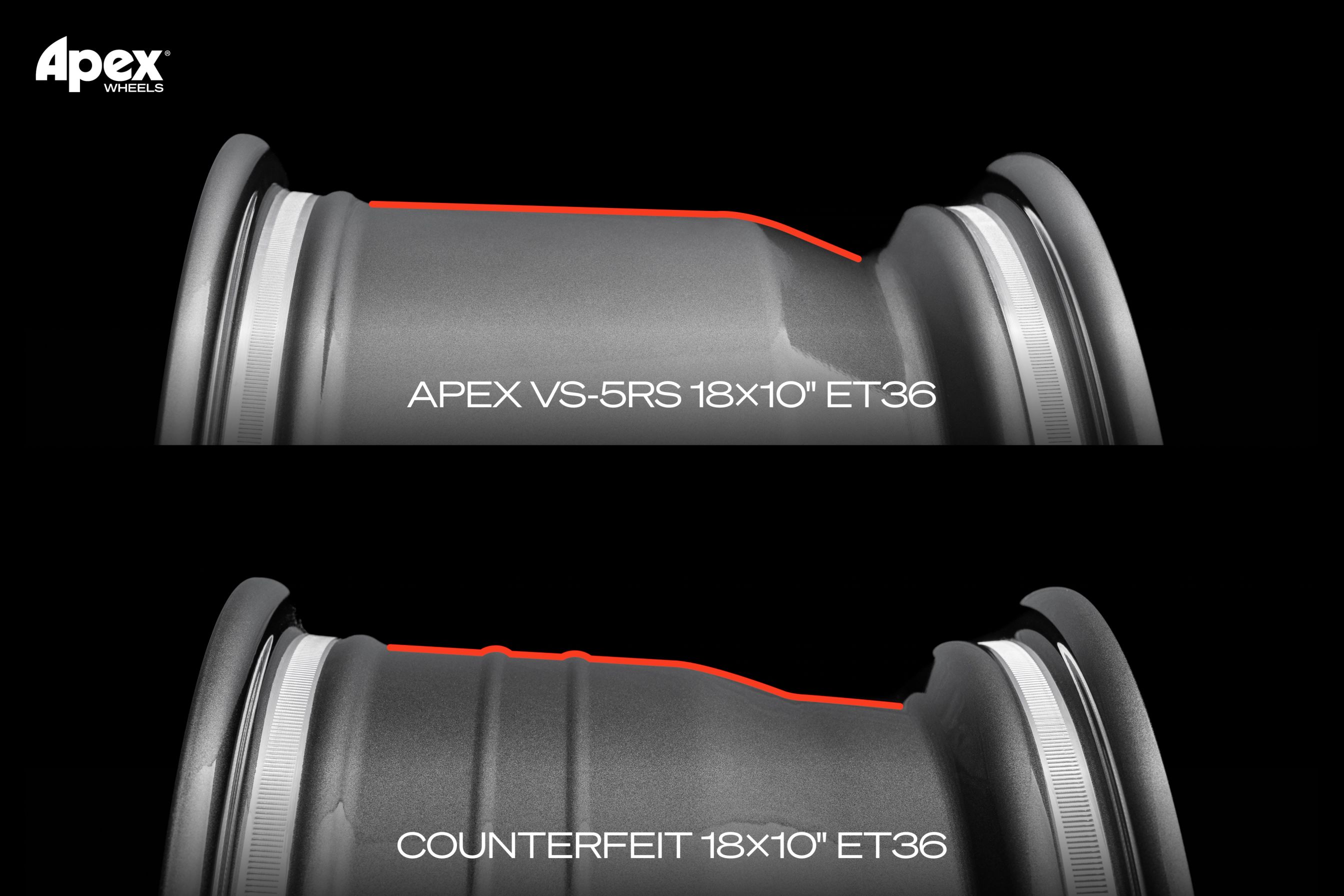
One of the easiest ways to spot a fake is by looking at the barrel. Authentic Apex wheels have a distinct barrel profile with a more aggressive dropwell to maximize brake clearance. Our barrel profile and our Sprint Spec inner lip can’t be replicated by counterfeiters, as every counterfeit wheel is made using cheap forging blanks that don’t have material in the right locations.
Additionally, our barrels never have ring lines on them. If you see any, you know immediately they are not authentic products.
Fakes Have Inferior Brake Clearance
The problem with cheap tapered barrel designs is the barrel getting tighter as you move closer to the face of the wheel, which compromises caliper clearance, as seen in the illustration below.
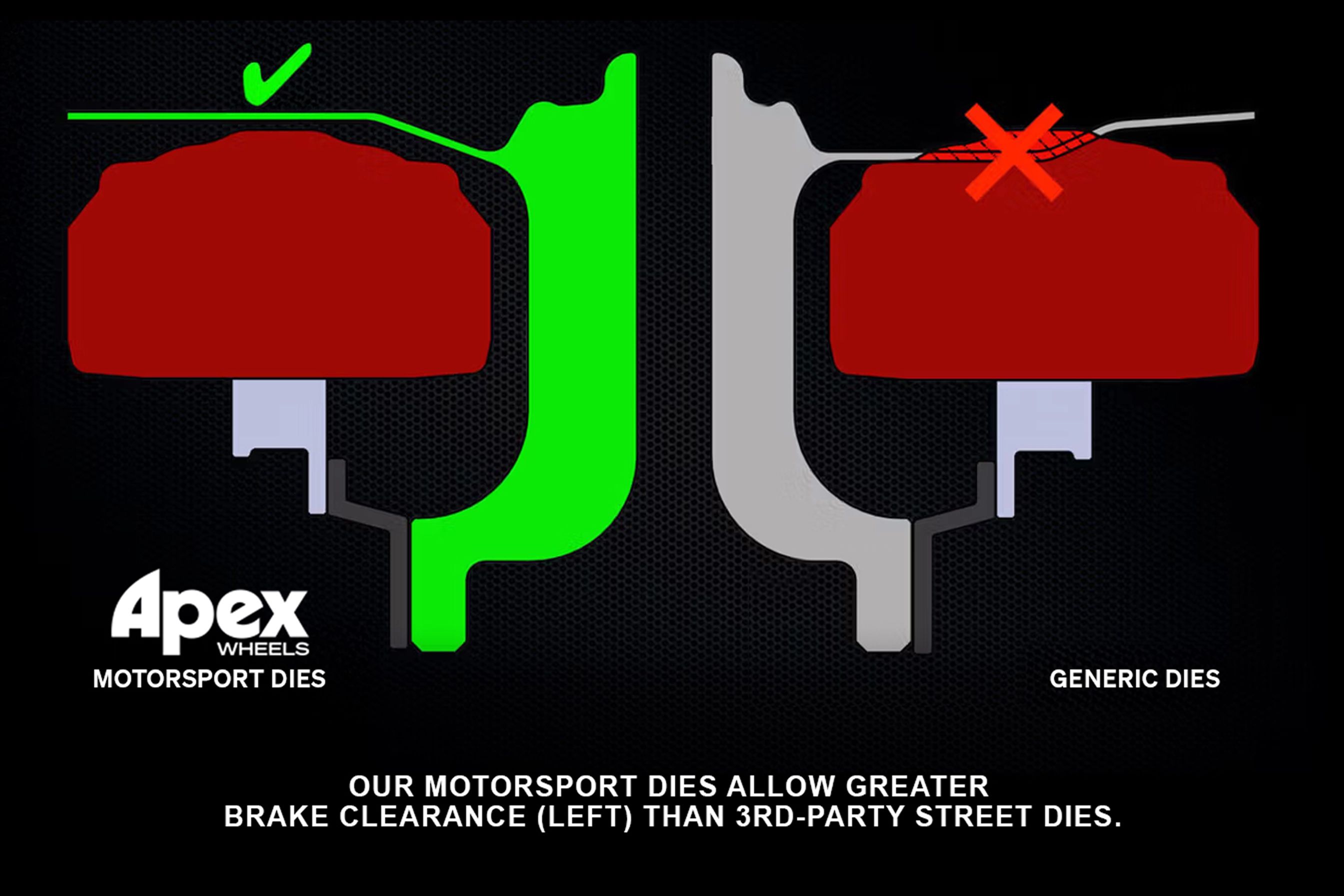
As a practical example, our high clearance barrel design allowed us to produce 18” wheels specifically for the F8X chassis M3/M4 that will clear the OE 380mm brakes, which wasn’t possible with more traditional tapered barrels.
Fakes Have Primitive Mounting Pad Designs
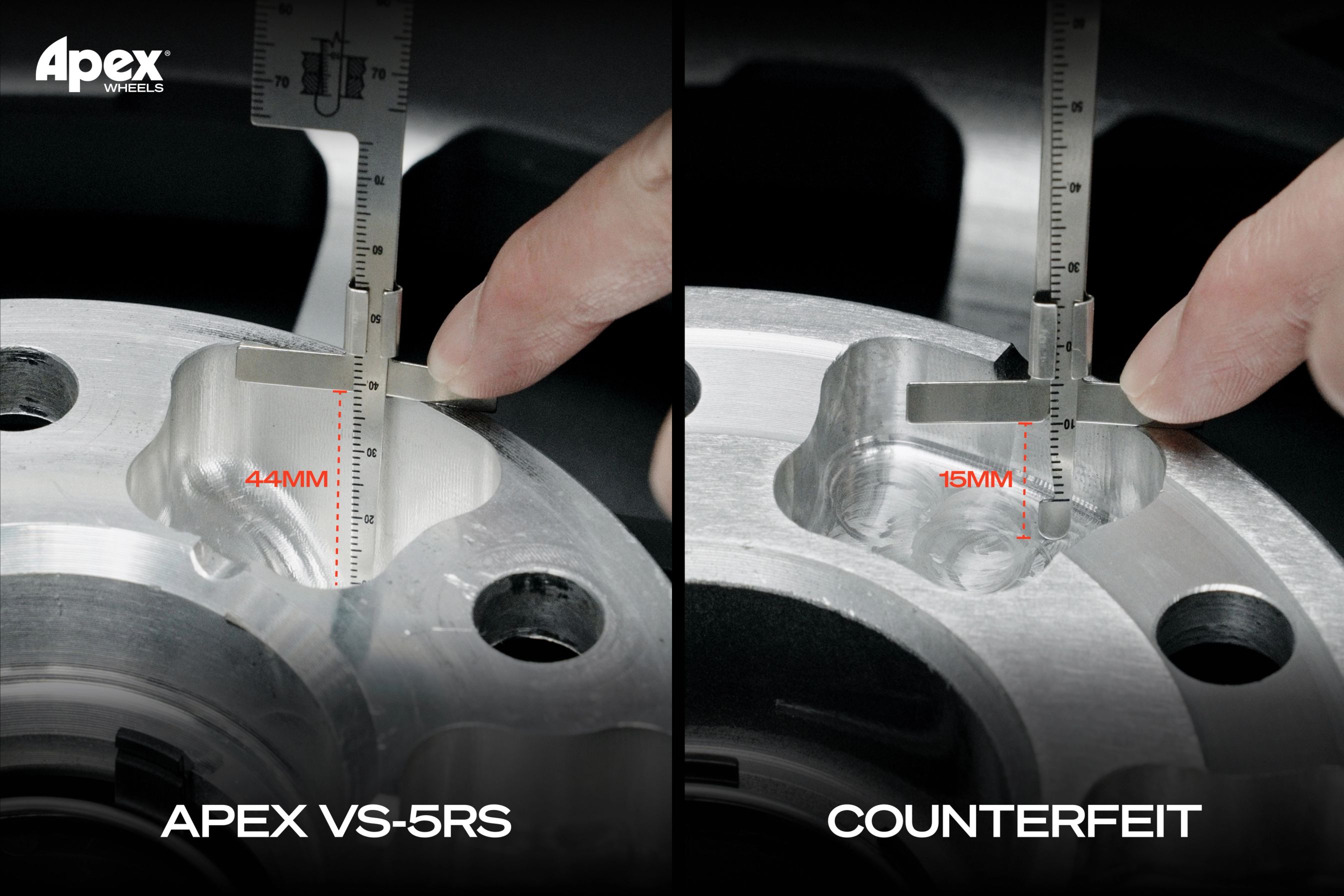
The Apex rear hub pocketing is ~3x deeper than the counterfeit – over a full inch deeper. Photos on our website don’t show off this section well and it takes time to model this correctly without compromising the strength of the wheel. Because of this, it doesn’t get copied by counterfeiters.
It’s a significantly more expensive design choice optimized for weight reduction, as it requires more complicated engineering and longer machining time to remove that extra material. That’s not critical when spitting out high profit margin fakes.
Fakes Can’t Match Our Lip Profile
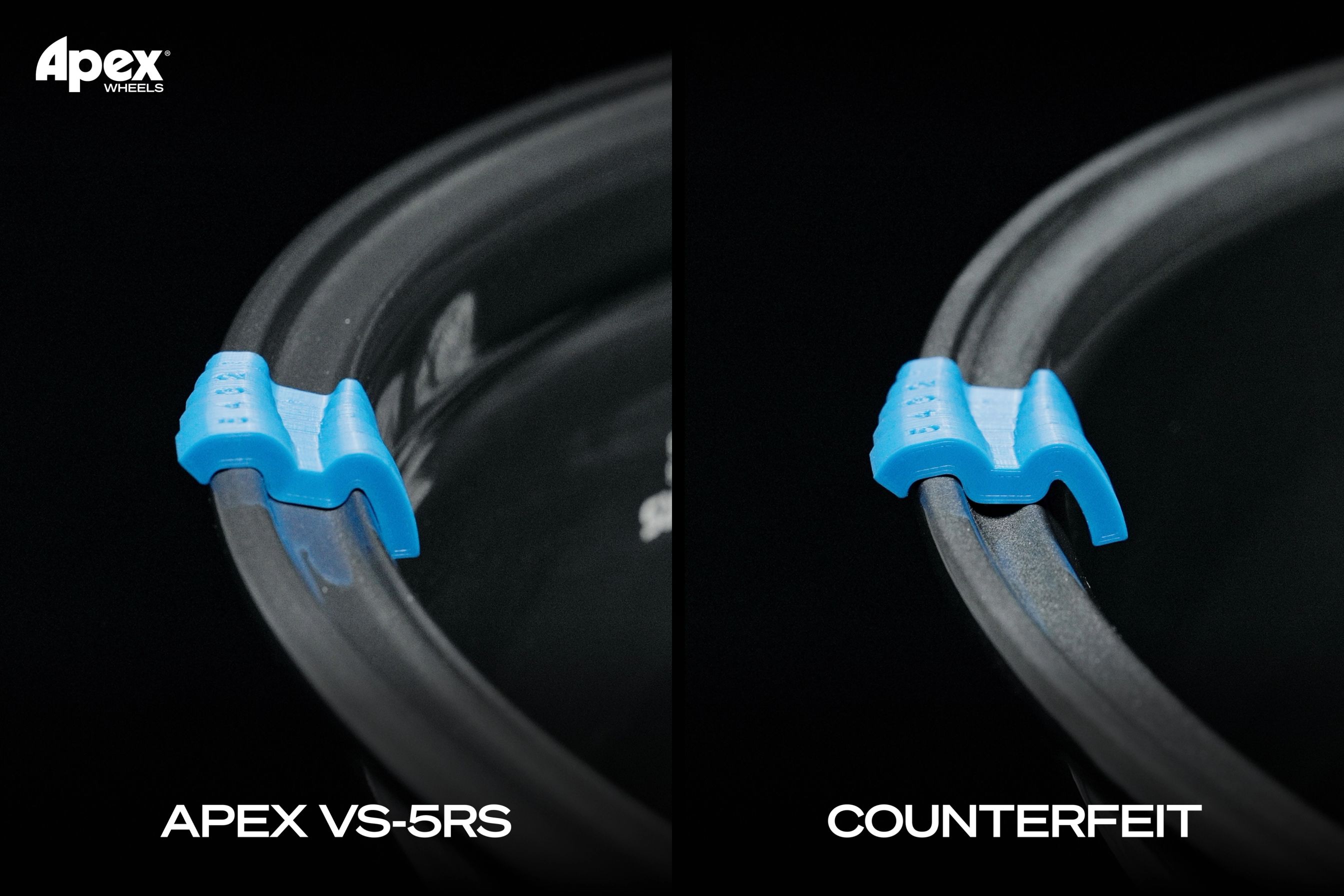
One of the most beneficial and hardest to implement features on our forged wheels is our Sprint Spec inner lip. Visually the design is simple and unassuming, but the location of that material makes a huge difference in how it performs. Getting material into what we internally nicknamed the “chin” of our lip was one of the primary reasons it took years for us to design our own forging dies that had enough material in the correct area to make that chin possible. Traditional blanks lack this extra material, so counterfeiters can only mimic the look by cutting deeper into a regular lip to create a C-channel look. Although it only looks like a few millimeters of difference, the effectiveness of the material when properly placed changes drastically.
Our Sprint Spec inner lips use just 0.1lbs of extra material for their design, but the difference in engineering is stark. The counterfeit inner lip is 15.5% less stiff and 8.4% weaker than our inner lip despite the minimal amount of material difference.
For more information about our Sprint Spec inner lip design and what makes it such an important feature, reference this article: Meet the Stronger Apex Sprint Spec Inner Lip
Fakes Don’t Fit Caps Well
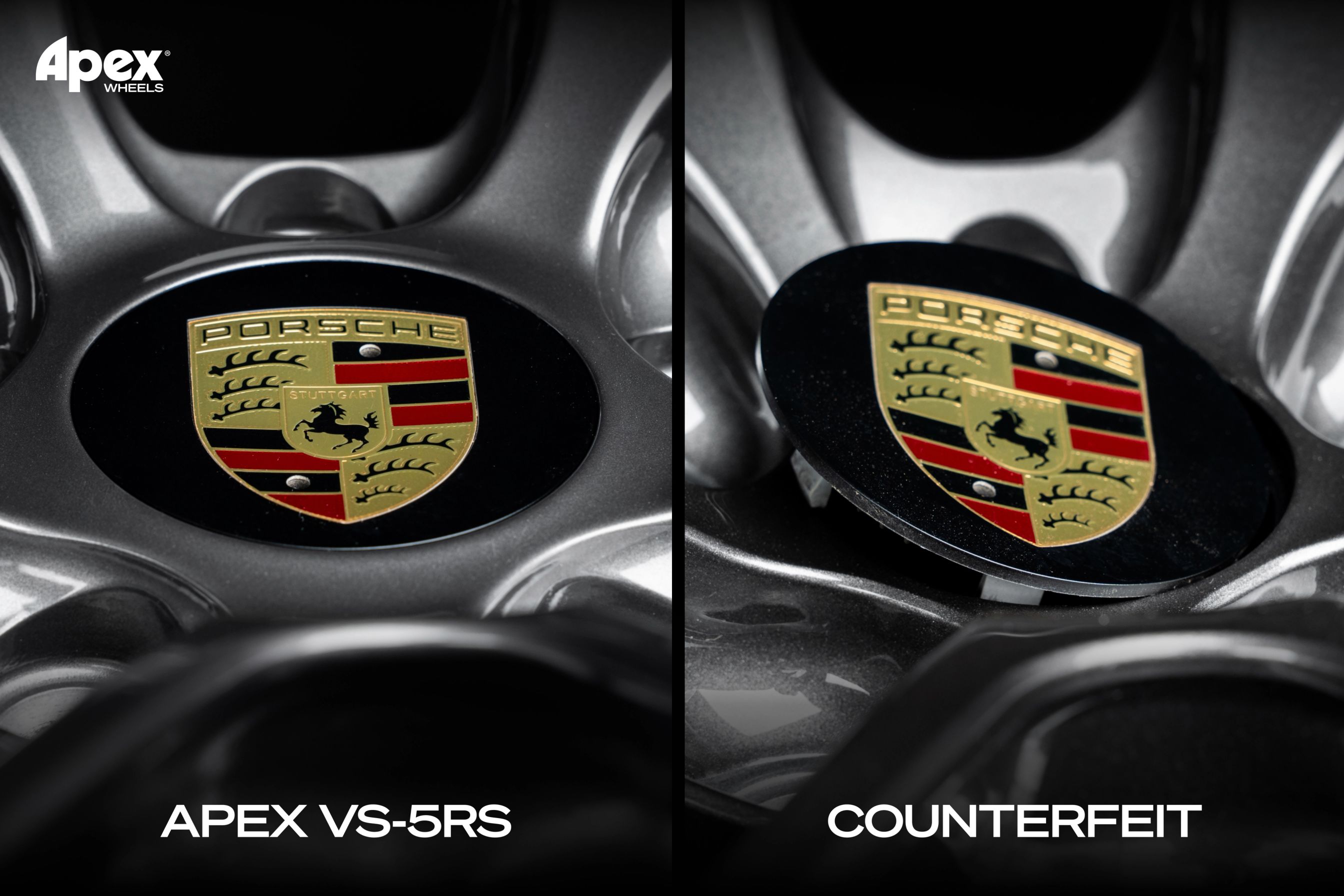
Another commonly overlooked feature of authentic Apex products is OEM center cap support for most of our wheels. This is a feature that many customers don’t even realize they’re looking for, until they want to run a clean, OEM+ look with factory center caps.
The counterfeit wheels we tested did not share this feature. Instead, they used generic-fit center caps with a diameter and attachment style that didn’t mirror any OEM caps that we are aware of. This compatibility issue wasn’t disclosed before we purchased this counterfeit set, and we’ve had multiple instances of customers who purchased fake products reaching out to us to buy authentic center caps, only to find that they won’t fit.
Fakes are Heavy in Odd Places
Other small but important differences exist across the counterfeit product. It’s impossible for us to list every possible difference between the wheels as literally everything is different.
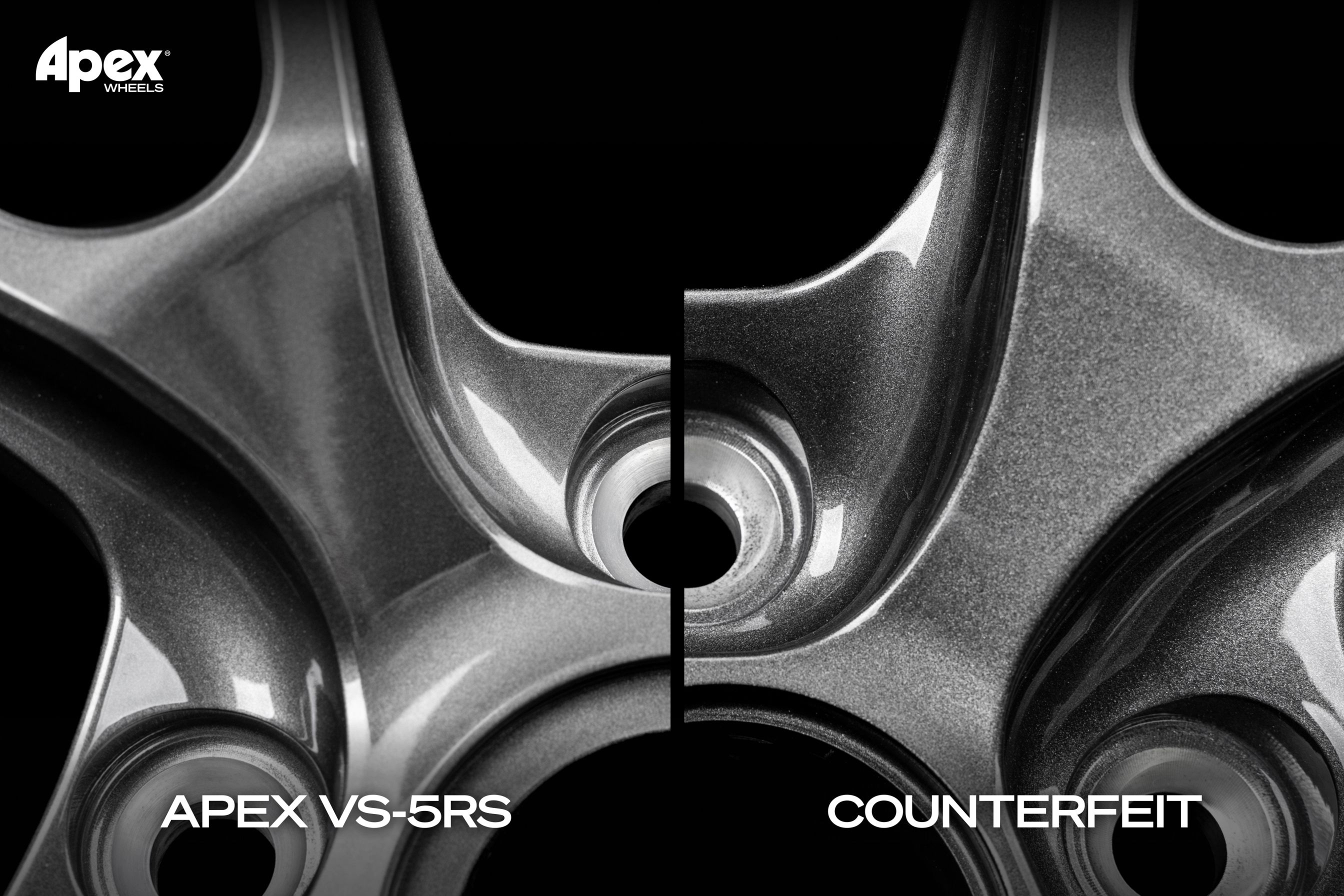
For example, in the image above you can see excess webbing above the lug hole. This likely stems from minimal and rushed Finite Element Analysis (FEA) in an effort to save time and cost, rather than properly optimize the strength and weight of a wheel. This is the difference between amateur design and our team of engineering professionals who spend months optimizing new wheels. Differences like this are what adds up to the significant weight increase compared to authentic wheels.
Testing and Certification
All counterfeiters lie about testing and certification to save themselves a fortune at the buyer’s risk/expense. They are either not conducting tests at all, or they are not testing to the required levels. It’s almost always just skipped.
The counterfeit set we ordered showed definitive proof that the testing standards they claim to meet are objectively false. The wheels we purchased were engraved with “JWL/VIA” on the barrels of the wheel, along with a claimed 720kg load rating. To a misinformed customer, this looks completely legitimate and in theory adds a lot of value. Unfortunately, in the US there is no agency that enforces the legitimacy of these markings. Companies can make claims about testing with little repercussion, and in this case it’s easy to show that the engravings are false.
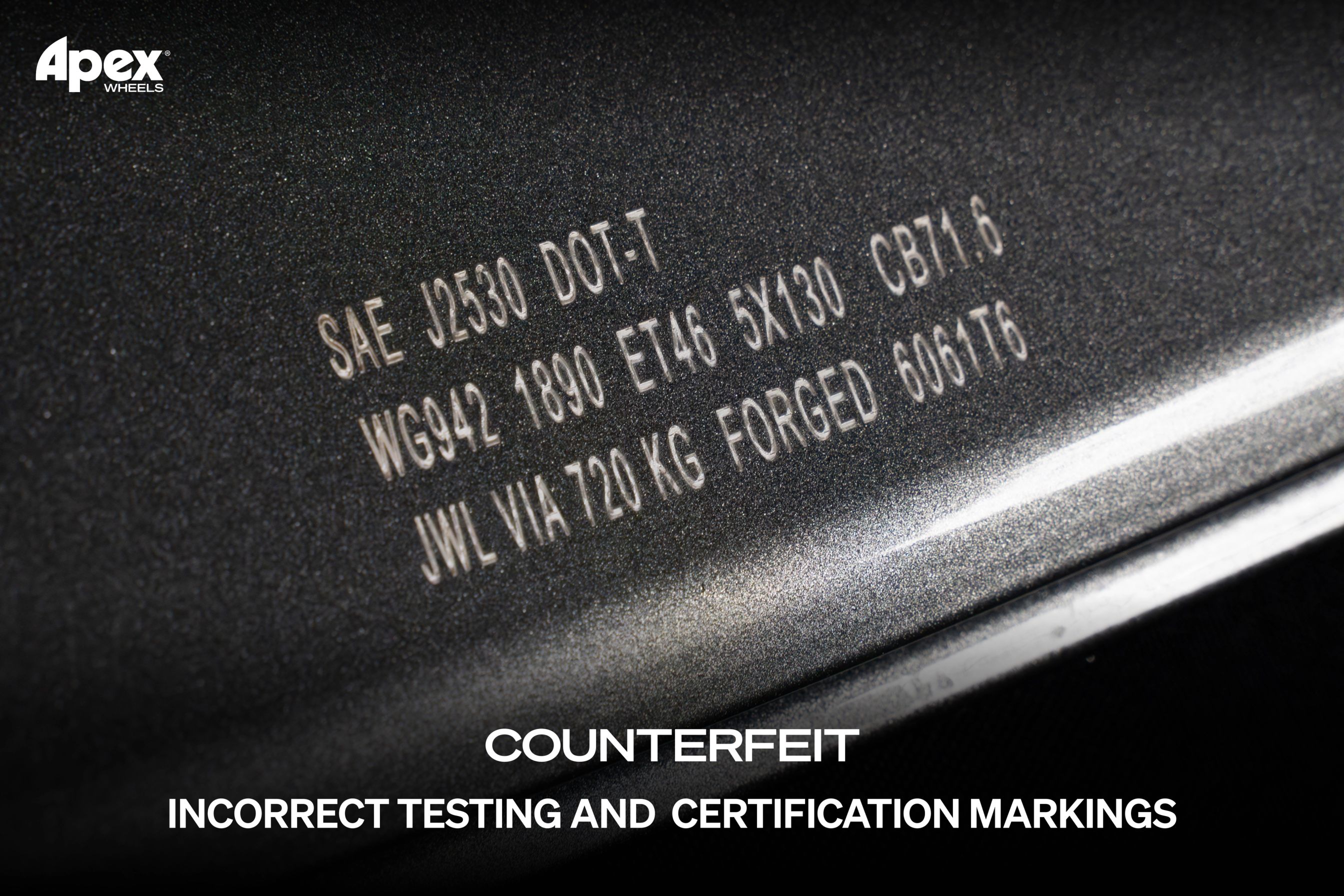
The JWL standard for 5x130 bolt pattern wheels requires wheels to be manufactured and destructively tested to a 735kg load rating - FEA simulations do not count. Since they are labeled below the required load rating, these wheels are immediately not JWL compliant and should not be stamped with the JWL marking. Any legitimate manufacturer would never go through costly destructive testing at a load that is lower than required. Counterfeit factories don’t care. They engrave it and ship it, saving time and costs while leaving the end customer in the dark and carrying all the risk.
Similarly, the VIA requires wheels to be sent to their laboratory in Japan for independent physical testing to verify the JWL standards. They will not certify or even begin a test on a wheel that has the wrong load rating engraved on it. Because the counterfeit wheel we received is marked incorrectly for the JWL standards, it could never qualify to be tested by the VIA. Therefore, their use of the VIA logo is also fraudulent. Plus, if it were registered, it would be listed in the VIA’s online database of results that professional wheel manufacturers can see. (Hint: it’s not in the results database)
These are also falsely stamped SAE J2530. This is a completely different test which isn’t automatically met while doing the JWL testing. SAE testing requires six destructive tests at different load parameters, so you can’t run a test and claim it’s both JWL and SAE. The SAE test requires six additional wheels to be manufactured and then destroyed for every single fitment that is produced. At the price points of counterfeit wheels, testing to any one of these standards is prohibitively expensive, let alone all of them.
From a cost and timing standpoint it’s impossible for counterfeit manufacturers to test to the standards they claim to meet, and once people understand the numbers that go into it, it becomes obvious. To us, hearing their testing claims is like hearing someone say they slow smoke ribs in two minutes.
Don’t get fooled by the footage of a single test as these companies adapt to intensifying scrutiny. They can make ringers, and the tests are not independently run. It’s easy to run one test, but it would take hundreds of tests or more to match the scale of their claims. They’re saving millions in testing costs.
Wheel load ratings are a critical safety element of a vehicle, and objectively false claims like what we saw on our counterfeit set should raise major red flags for any potential consumer. If a counterfeit seller is willing to lie about something as critical as load rating, what else are they willing to lie about? These money saving short cuts are what makes them so dangerous to do business with.
Conclusion
For almost two decades, Apex has been designing wheels with one specific goal in mind: performance above all else. We’ve been manufacturing wheels since long before counterfeits started to appear, and that philosophy has never wavered.
If nothing else, we want enthusiasts to take away the following from this article:
- Counterfeit wheels do not come from the same factory as authentic Apex wheels.
- Our manufacturing partners are professional, and optimized for our high volumes and the volume of OEMs. It would be silly of them to sell one set at a time and lose our volume business over trademark infringement.
- Counterfeit wheels are not made from the same forging blanks.
- They buy cheap, thin blanks and distort designs to fit within their restrictive dimensions.
- Counterfeit wheels are not based on our design files.
- While the wheels may look similar at a quick glance, each dimension is measurably different. The counterfeit product is designed based only on photos of our wheels. They don’t have access to samples or data files.
- Counterfeits are made by amateur engineers that are rushed to mimic a design.
- Counterfeit manufacturers use primitive mesh models and conduct basic FEA. They can’t afford the time to invest into doing it well, and their wheels are heavy as a result.
- Counterfeit listings promote fake/false certificates and testing documents.
- Your safety is at risk. Testing has been totally thrown out the window.
- All Apex designs are independently tested by third party labs to verify the engineering that we put into our products.
Real Performance means real engineering, and that’s something you can only get when you buy from a company that’s run by enthusiasts for enthusiasts.
It’s clear that counterfeiters and influencers have a strong motivation to spread false narratives that counterfeit wheels are related to authentic products, or are equal in quality. Some influencers might even believe the misinformation and aren’t spreading it with intentional malice, but that would require blindly trusting and parroting the information they’ve heard (without proof) from questionable sellers on questionable marketplaces. People with a platform have a duty to their followers to research and vet information and prevent the spread of fake news which harms the enthusiast community. It seems some people really do believe everything said by the guy selling the $200 Rolex from his trench coat.
The saying “If it sounds too good to be true, it probably is.” absolutely applies here. Consumers should be wary of the opinions and misinformation being spread about counterfeits and “backdoor deals”. Influencers sharing affiliate links or offering to connect you with specific suppliers aren’t revealing a secret source, they’re earning a commission when you click and buy.
Don’t be fooled - the quality, engineering, and support for these counterfeits is inferior to real Apex wheels. Please reach out to us via our contact form if you’re looking at a set of new or used wheels and you’re concerned about their authenticity. We’ll gladly take a look at a listing and help determine if they’re real or not.
Tags
 Dan Cope
Wheel Fitment. Launch Alerts. Real Info Only.